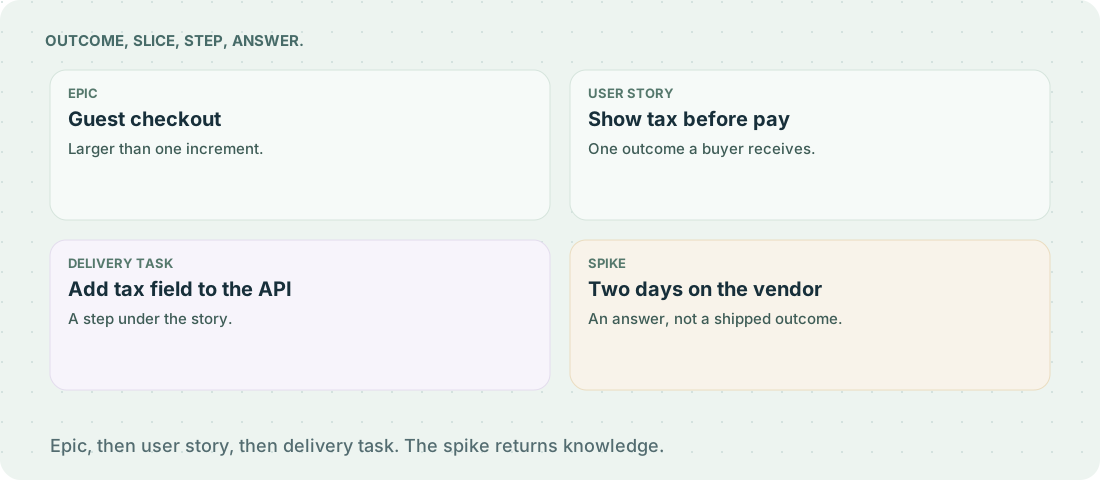
An epic is a work item larger than one delivery increment. A user story is one outcome valuable to a user. A delivery task is the technical step under that story. A spike is a time-boxed work item whose result is knowledge. Velocity is the sum of story points completed in one sprint.
Guest checkout is not a story, and the application programming interface (API) field is not one either
Fictional Lantern Works wants guests to pay without an account. The backlog has "Guest checkout", "Show the tax before pay", and "Add tax to the application programming interface (API)", all estimated as "5". The sprint report adds those fives and calls the total velocity. The column is a work item list. The cards are not the same kind.
A work item is a task tracked on a delivery backlog. An epic, a user story, a delivery task, a bug, a spike, and a technical-debt item are kinds of work item. The general task is any assignable piece of work, including work that is not on a delivery backlog. A technical step under a story is a delivery task, not a second meaning of task. A requirement is a representation of a need. The work item may satisfy that need, and a user story's text often is that representation. When both are recorded, requirement work item links them. User story vs use case vs requirement is that split.
The epic is the parent
The epic is split into smaller work items such as user stories. The Scrum Guide does not define an epic. Some writers call an epic a large user story before it is split. In this graph the epic is the parent, so it is not recorded as a user story. "Guest checkout" is that parent in this invented backlog.
A sprint is a fixed-length iteration. In Scrum it lasts at most one month, with a start day and an end day. It may run inside a project and may be recorded with none. The Scrum Guide does not make a sprint part of a project, and it does not define story points or velocity. An epic can stay open across several sprints. A release is a version made available for use, and it may contain work from several epics or from only part of one. The parent link is not the project and not the sprint. Unfinished work stays a work item.
The story, then the delivery task
A user story is often told as who wants what and why. "Show the tax before the buyer pays, so the total is not a surprise" is the story. A use case narrates how an actor reaches a goal and is not itself a backlog item. The story's text is often a usable representation of a stakeholder need. The story is not an acceptance criterion. A criterion can check the story, a requirement, or a service.
Planning conversations often call a delivery task a task. "Add the tax field to the API" is the step that carries out part of a story or another backlog item. It does not by itself promise an outcome a user receives. The hierarchy here is epic, then user story, then delivery task.
The practice behind a spike comes from Extreme Programming and is used with Scrum. The Scrum Guide does not define it. "Spend two days learning whether the tax vendor answers quickly enough" is a spike. The two days are part of the example, not a standard length. The time box belongs to the spike. A sprint is not another name for one.
Points and velocity stay inside one sprint
Story points are a relative estimate of size. The Scrum Guide does not define them. Teams most often point a user story, and sometimes a bug or a spike. The points are not hours, and a total is not comparable across teams as a unit of time. An epic is usually left unpointed, because its size is the items under it. The invented "5" on the epic was the first thing to take off.
The Scrum Guide does not define velocity. Adding the velocities of several sprints does not produce a larger velocity. It is not deployment frequency and not a DevOps Research and Assessment (DORA) metric. Lead time for changes runs from a commit until the production deployment. DORA metrics and mean time to restore (MTTR) is that measure alongside the others. Cycle time runs from when work starts until that work is finished. The length of a sprint is not a cycle time.
| Card | Kind | Invented Lantern example |
|---|---|---|
| Guest checkout | Epic | Larger than one increment; the parent, not itself a user story |
| Show the tax before pay | User story | One outcome a buyer receives |
| Add the tax field to the API | Delivery task | A technical step under the story |
| Will the tax vendor answer in time? | Spike | A time box that returns an answer |
| This iteration | Sprint | A fixed length. In Scrum, at most one month. A project is optional |
Status is where the card sits in the team's workflow. The state names belong to the team. Status is not priority, and it is not which sprint the item is in. The figures in the table are made up so the kinds stay visible.