A country is one country or territory identified independently of any one spelling. A country in the Countries reference database is that place, keyed by its two-letter code. A country alias is an alternative name that refers to the same country. An alternative country name is that alias. A short name, also called a common name, is the everyday form, such as United States. An official long name is the formal name of the same country, such as United States of America. A former name, or historical name, is an earlier name, or a name a dataset still writes after the short name changed, such as Czech Republic for Czechia. A name in another language is another language's name for that country, such as Deutschland for Germany. An abbreviation is a shortened form of the name, such as UK for the United Kingdom or USA for the United States. A country code is an identifier published by the International Organization for Standardization (ISO) in ISO 3166-1, the part of that standard that lists countries and territories. An alpha-2 code is the two-letter form of that country code. An alpha-3 code is the three-letter form. A numeric code is the three-digit form.
Short names and official names
The shared country value labelled United States records the English aliases USA, US, United States of America, and America. United States is the short name. United States of America is the official long name. USA and US are abbreviations. America is a familiar name that value records. The same word also names the continents, so the alias is a recorded spelling for this country. A sentence about the continents is a different use of the word.
The value labelled United Kingdom records UK, Great Britain, Britain, and United Kingdom of Great Britain and Northern Ireland. United Kingdom is the short name. United Kingdom of Great Britain and Northern Ireland is the official long name. UK is the abbreviation many files write. Great Britain and Britain are familiar names people use for the country. Strictly, Great Britain is the island of England, Scotland, and Wales. The alias records the spelling people used. It does not redraw the island.
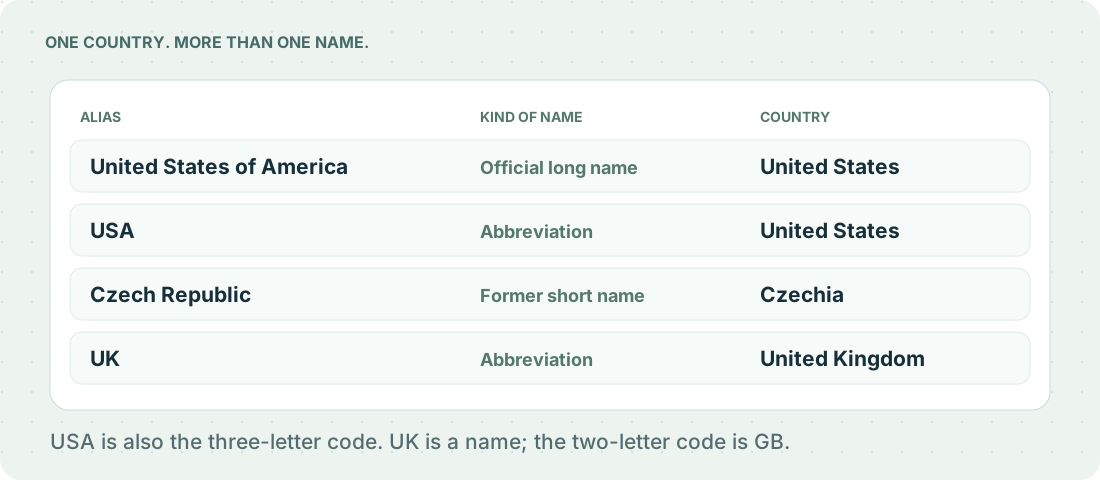
| Alias | Kind of name | Country |
|---|---|---|
| United States of America | Official long name | United States |
| USA | Abbreviation | United States |
| Czech Republic | Former short name | Czechia |
| UK | Abbreviation | United Kingdom |
These four spellings are recorded on the shared country values. USA, Czech Republic, and UK are also rows in the countries alias table, because a sample dataset stored them.
Former names and small spelling differences
Czechia is the English label on the shared country value, and it is the name on the countries row. Czech Republic is an alias of that value. The countries alias table maps Czech Republic to the Czechia row because Chinook's billing country stores that former short name. Czech Republic is also still the official long name. The short name in the reference list is Czechia. The longer formal name has not been retired.
The countries row for the Netherlands is named The Netherlands. Chinook's billing country writes Netherlands, and that spelling is an alias row pointing at the same country. The shared value is labelled Netherlands and records The Netherlands and Holland as aliases. Holland is a familiar name for the whole country, and it is also the name of a region inside it. The alias says this spelling was used for the country.
Myanmar is the name on the countries row. Burma is the earlier English name for that country. The alias table does not list Burma. A former name becomes an alias when a dataset records the mapping. Being well known does not add the row by itself.
Names in other languages
Deutschland is the German name for Germany, which is why the two-letter code is DE. The shared country values also keep a Russian label beside the English one. The Russian label for the United States is США. A label in another language is still a name of that country.
The countries alias table lists spellings the sample datasets store, and each row names its source. It is not a dictionary of every translation. Deutschland is a real alternative name, and it is not a row in that table. An unlisted spelling stays unmatched until someone records it.
Why the alias is its own entity
A country row holds one name. The alternative spellings are separate country alias rows. The alias text is the identifier. The country_iso2 field points at the country. The source says which dataset used that spelling.
One country can have several of those rows. The United Kingdom row is named United Kingdom. One alias is that same text, United Kingdom, from Chinook billing country, where it matches the country name exactly. Another is UK, from Northwind, including shipping country. The United States row is named United States, and USA points at it because Chinook billing country writes USA.
Extra columns on the country, such as a short name, an official name, and a former name, would pick a few roles and one value each. The next dataset can still spell the country another way, and the column would not say where the spelling came from. A new alias is one more row, and the source stays with the spelling.
The shared country value keeps a short alias list on the value itself, beside the label and the codes. That list is part of the vocabulary. The countries graph uses an entity when the alias is a row from another dataset. The list defines names the country answers to. The row records a spelling a dataset actually stored.
How aliases help matching and search
USA, United States, and US are one country written three ways. A name column is matched through labels and aliases. Czech Republic follows the alias to Czechia. UK follows the alias to the United Kingdom. Netherlands follows the alias to the row named The Netherlands.
A spelling with no alias and no label stays unmatched. The country guide says an unrecognised label should be checked. Guessing the nearest name makes a join look successful while the geography quietly changes.
Search uses the same link. A query for an alternative spelling can land on the alias and follow country_iso2 to the country. The result is the place, reached through the name the reader typed.
An alias and a country code
A country code is assigned in ISO 3166-1. The alpha-3 code on the countries row is that three-letter code: USA for the United States, CZE for Czechia, and GBR for the United Kingdom. The numeric code for the United States on the shared value is 840. The country-codes guide sets out the two-letter form, the three-letter form, and the three-digit form, including the joins that break when a code is read as a name.
USA is the three-letter code and a common alias. US is the two-letter code and an alias on the shared value. A name column that says USA is matched as an alias. A code column that says USA is looked up as the alpha-3 code. UK is an alias for the United Kingdom. The two-letter code is GB. The country-codes guide explains that UK is exceptionally reserved, while GB is the alpha-2 code.
The alias table and the code columns answer different questions. The alias says which spelling a dataset used. The code says which identifier the standard assigned. Keep the column labelled with the one it holds.
The name, the code, and the role
Billing country and shipping country can share one country after the spelling is resolved. They still describe different facts: where the invoice was addressed, and where the goods were sent. The billing-country guide keeps that role in the name of the field.
Resolve the alias or the code first, so the spelling becomes one country. Then keep the role. A precise name for the column is what lets the next reader trust the join.