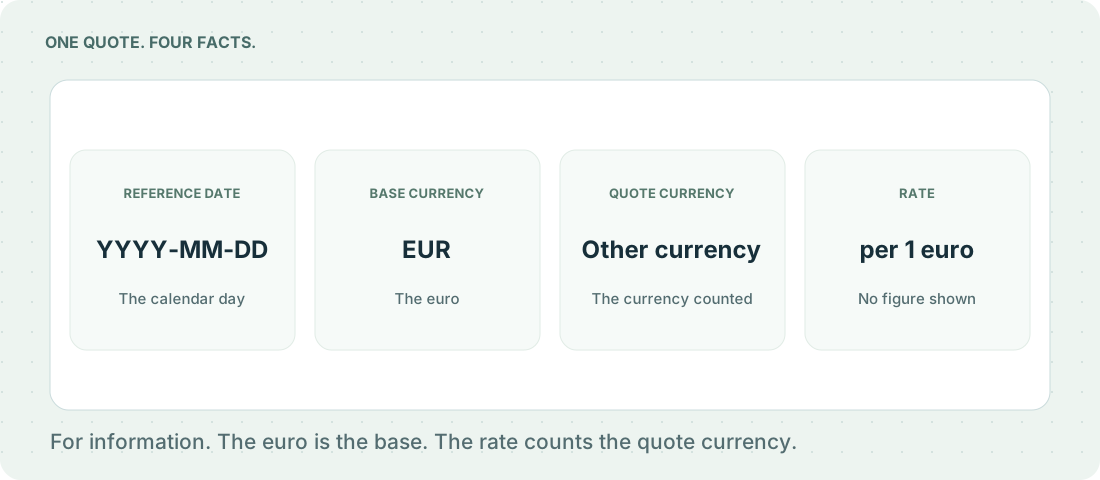
The ECB is the European Central Bank. FX means foreign exchange. A currency is a unit of money identified by an International Organization for Standardization (ISO) 4217 code. An FX reference quote is a foreign exchange reference quote: one indicative observation that relates two currencies in an explicit direction, for one reference date, under a provider's methodology. An FX reference rate is the indicative foreign exchange reference rate on that quote: the positive number of quote-currency units per one unit of the base currency. A quote currency is the currency the rate counts. A reference currency is the currency the rate is quoted against; MeaningGraph records that role as the base currency. A reference date is the foreign exchange reference date: the calendar date the quote applies to, with no time of day and no time zone. A ref date is that same reference date, under the shorter name. The European Central Bank's euro foreign exchange reference rates use this pattern with the euro (EUR) as the base currency: an ECB indicative reference rate on an ECB daily reference quote, for one ECB reference date and one ECB quote currency, with the euro held as the ECB base currency.
What the European Central Bank publishes
The ECB's euro foreign exchange reference rates page says the rates are usually updated at around 16:00 Central European Time (CET) every working day, except on TARGET closing days. TARGET is the Eurosystem's settlement system, and those are the days it is closed. The rates are based on a daily concertation procedure between central banks across Europe, which normally takes place around 14:10 CET. The page says the rates are published for information purposes only, and it strongly discourages using them for transactions.
The ECB's framework for the euro foreign exchange reference rates uses the same boundary. In that document, a reference rate means an exchange rate that is not intended for market transactions, whether directly or indirectly as an underlying benchmark. The rates are intended for information purposes only. The framework says the rates are determined daily around 14:10 CET and published around 16:00 CET.
On the rates page, the listed currencies are quoted against the euro, and the page calls the euro the base currency. The daily Extensible Markup Language (XML) file names the sender as the European Central Bank and the subject as reference rates. It carries one reference date, written YYYY-MM-DD, and one rate for each quoted currency. It does not include a row for the euro. In the registry, that missing row is deliberate: the ECB base currency is context for the direction of every quote, not a quote of the euro against itself and not a rate of one.
The ECB indicative reference rate is the figure for one quoted currency on that date: quote-currency units per one euro. The registry keeps the ECB's decimal string as supplied, including trailing zeros, and does not rewrite it as a binary floating-point number or a single fixed scale. It is not a money amount. A reciprocal, a cross rate, a daily average, a closing price, and a transaction price are different questions.
Reference date and ref date
A foreign exchange reference date extends date. It names the calendar day a foreign exchange reference quote applies to. It carries no clock time and no time zone, and it does not record the publication instant, the download instant, or the 14:10 CET concertation as a timestamp. Ref date is the short form of reference date. A search for "ref date" is a search for this day.
The ECB reference date is that day as the daily file states it. A different requested date stays unavailable. The concept does not fill the gap with the latest day.
The framework allows the ECB to amend and republish a rate. It also says the ECB will not amend or republish a euro foreign exchange reference rate after it has published the rate for the same currency on the following business day. A reference date and a quote currency can therefore show up again in a corrected publication. Those two fields do not, by themselves, identify one immutable observation. The foreign exchange reference quote is the observation under the provider's methodology, and the same date and currency pair may be republished.
Reference currency, base currency, and quote currency
| Term in the question | Concept | What it records |
|---|---|---|
| Reference date, or ref date | Foreign exchange reference date | The calendar day the quote applies to |
| Reference currency | Foreign exchange base currency | The currency in the denominator |
| Quote currency | Foreign exchange quote currency | The currency the rate counts |
| Foreign exchange reference rate | Indicative foreign exchange reference rate | Quote-currency units per one base-currency unit |
| European Central Bank reference rate | ECB indicative reference rate | Quote-currency units per one euro on the ECB reference date |
Reference currency, in this question, means the currency the other rates are quoted against. MeaningGraph records that role as the foreign exchange base currency. The rate expresses units of the foreign exchange quote currency per one unit of the base currency. For the ECB daily publication, the base currency is the euro, and each ECB quote currency is one other currency in that day's file.
A quote-currency code names a currency. It does not name a country, a period of legal tender, or the currency printed on a particular invoice. The core currency values are a starter subset: euro, US dollar (USD), and pound sterling (GBP). The ECB file quotes further currencies. A code that is absent from the starter subset can still be an ECB quote currency. The subset is not an allowlist for the file.
Reading the rate backwards, as euros per one unit of the quote currency, is a separate calculation. So is a cross rate between two quote currencies. Either one needs an explicit arithmetic and rounding policy. The figure in the ECB file is the direction the file states: quote-currency units per one euro.
The rates page also records a suspension. Owing to trading activity in the euro/Russian rouble market, the ECB says it is not in a position to set a reference rate that is representative of prevailing market conditions. It has suspended publication of a euro reference rate for the Russian rouble. The page says the ECB last published that rate on 1 March 2022. In the registry, an absent quote stays unavailable. It is not stored as zero, and it is not stored as one.
What to keep with the number
A usable record of one ECB reference rate keeps the ECB reference date, the ECB base currency, the ECB quote currency, and the ECB indicative reference rate, read as quote-currency units per one euro. The missing letters beside 1,200 keeps a money amount attached to its currency. What is revenue? needs the same care when two invoice currencies are combined: a conversion has to name its rate, its direction, and its reference date.
The ECB publishes the figures on its own pages. This article does not copy a day's rates. The rate a bank applies to an exchange can be a different number, chosen for a transaction, on a different day.