The total that looked so reasonable
Fictional gallery Atlas Frame receives two invoices. One says EUR1,200. The other says USD1,200. A spreadsheet drops the currency column, adds the amounts and announces 2,400. It is an excellent sum of the numeric cells and an incomplete statement about money.
The missing letters are not decoration. They identify the units in which the amounts were expressed. Nobody would add twelve metres to twelve kilograms and proudly label the result “24.” Money often receives this courtesy only after the board meeting.
Give the number a travelling companion
The two 1,200 amounts can sit beside each other, but their currency tags must stay attached when the values cross into a chart, export or API response. The unit must survive the journey.
Money amount makes this dependency explicit: an amount needs its currency. Currency supplies named units with codes. The current core includes EUR, USD and GBP as a starter subset. That is a registry boundary, not a claim that the rest of the world's currencies have been discontinued.
A dataset can supply currency as a field on each row or state a fixed currency as context. Either way, a reader should be able to recover it. The invoice that arrived before the money shows that invoice totals inherit this need rather than escaping it.
Convert with the arrow visible
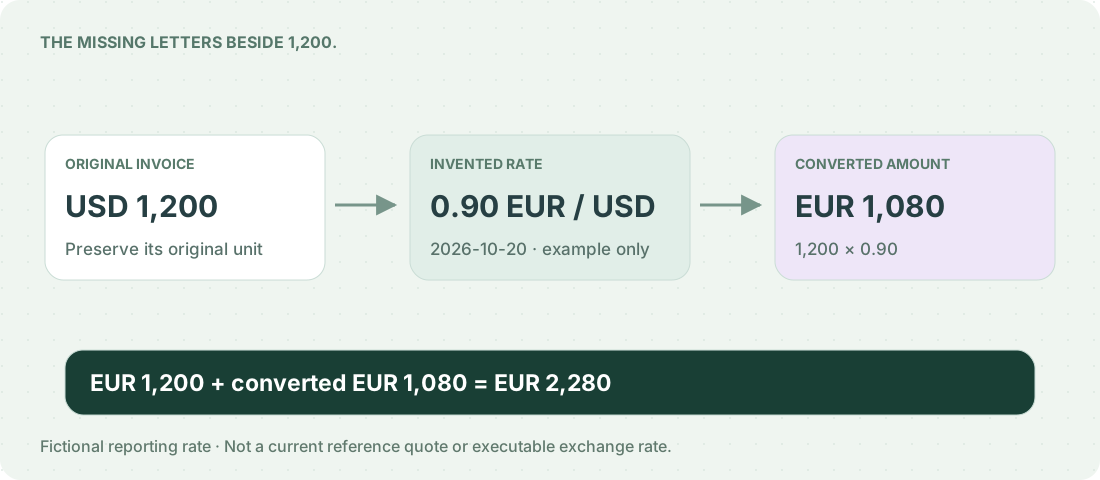
For an explicitly fictional reporting exercise dated 2026-10-20, suppose the chosen made-up rate is 0.90 EUR per 1 USD. The USD1,200 invoice becomes EUR1,080 under that assumption. Combined with EUR1,200, the illustrative converted total is EUR2,280.
The arrow matters: USD → EUR, multiply by 0.90. A reverse quote would express a different ratio and require a stated reciprocal calculation and rounding policy. Store the original amount, its currency, the chosen rate, its direction, its date and the reason it was used. Otherwise the converted figure becomes a number with a disappearing explanation.
The registry also defines Foreign exchange reference quote and Indicative foreign exchange reference rate. Those concepts describe indicative observations with provider methodology and reference dates. They do not promise transaction execution rates. A reference quotation and the rate a bank actually applies can belong to different questions.
Countries do not finish the sentence
Atlas Frame's supplier is based in one country, bills from another office and asks for dollars. A country code does not establish the invoice currency. A currency code does not identify the supplier's country. The two may be related in a particular dataset, but they are different meanings.
What is a country? follows geographic identity. Billing country follows a commercial role for that identity. Organization beyond the name follows the party behind the bill. Their interlinks add context without turning any one of them into a substitute for the others.
Keep the arithmetic explainable
Common traps include bare dollar symbols, rounding every intermediate line, averaging incompatible rates, and silently replacing a missing currency with a familiar default. Another is overwriting the original amount after conversion, leaving nobody able to reproduce the report.
The better question is not merely “what is the total?” It is “the total of which amounts, in which currency, using which conversion assumptions?” That sentence sounds longer than 2,400. It also survives the first sensible follow-up.