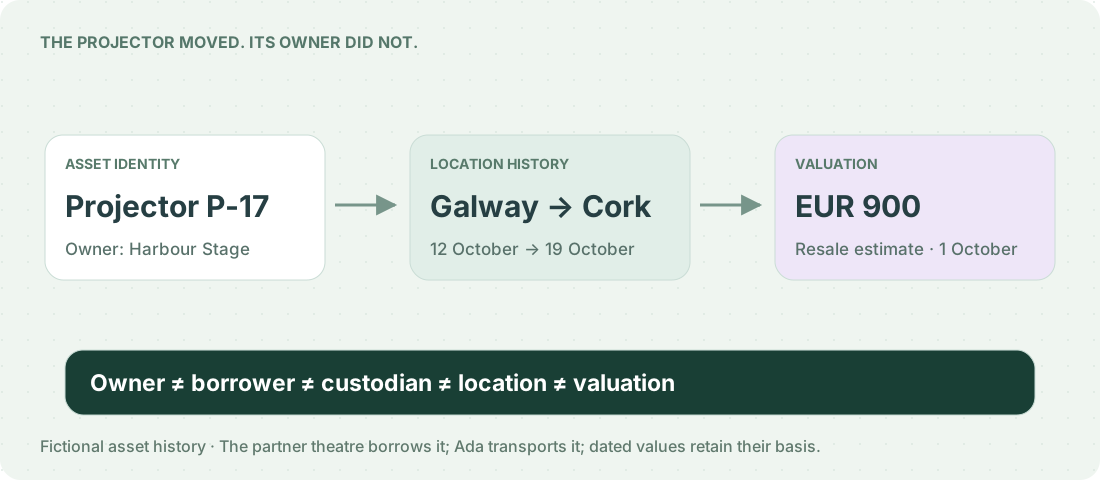
A projector goes on tour
Fictional arts company Harbour Stage lends projector P-17 to a partner theatre for a month. Technician Ada takes it to a venue in Galway. The inventory export has a column called owner, currently containing “Galway.” Finance asks whether the company has sold the projector to a city.
No sale took place. Someone used owner to mean “where we last saw it.” That shortcut worked while every projector lived in the office. The first loan revealed how much meaning had been packed into a convenient heading. A location had quietly been promoted to a party with property rights.
Four labels around one object
Follow P-17 through four separate connections: Harbour Stage as owner, the partner theatre as borrower, a city as its current location, and a dated amount as one stated valuation. The projector stays the same object while those relationships change independently.
This is an illustrative scenario model. Its useful question is what each relationship actually asserts: who owns the object, who uses it, where it is, and what a stated value measures.
Organization, City and Money amount can provide shared meanings for parts of that model. Reusing them does not create the connecting fields automatically. The arrows still need an owner, labels and a published explanation.
Ownership does not pack the van
Harbour Stage owns P-17 in this fictional example. The partner theatre uses it. Ada transports it. The Galway venue holds it overnight. A single ownerId cannot answer all four questions without changing meaning from one row to the next.
Organization beyond the name helps preserve the owner's identity across a rename. Person beyond the row follows Ada without making her the owner because she signed a collection form. Customer is a role offers a parallel lesson: relationships tell us how a party participates in a particular situation.
The same care applies when an organization controls or uses an item it does not own. A useful model describes those roles separately rather than inferring one from another.
Location needs a date too
On 12 October, P-17 is in Galway. On 19 October, it moves to Cork. Overwriting locationId answers “where is it recorded now?” but loses the history needed to investigate a missing cable or arrange a collection.
A movement record can preserve the location, effective time and source of the update. The precise design depends on the application. City is not a name explains why a place needs identity beyond its label, while an event has more than a timestamp helps distinguish the move from the later inventory update.
Value needs a question
A fictional EUR900 estimate dated 1 October might describe a resale estimate. A different amount could describe a replacement quote or original purchase price. Calling all three value erases the reason the numbers differ. None alone establishes any accounting recognition or treatment.
Currency is part of the number keeps the unit attached. The model should also preserve the valuation date, basis and source. A number without those companions is an invitation to compare unlike estimates.
Harbour Stage splits its overloaded column into explicit relationships. The next export is slightly wider. The projector is now recorded in Cork with its earlier Galway stay preserved, Ada still deserves her travel expenses, and nobody has accidentally sold equipment to a place name.