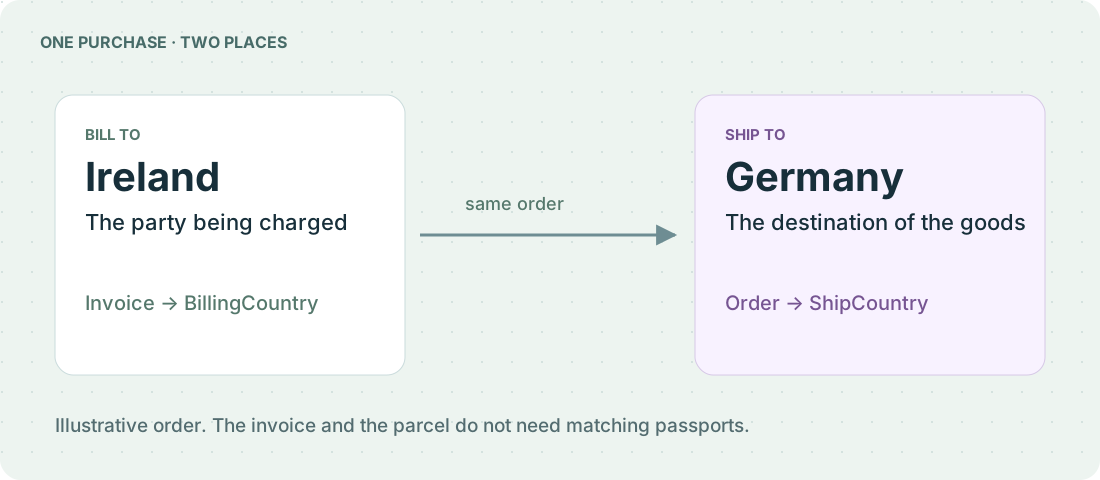
Billing country is the country an invoice is billed to. Shipping country is the country to which an order is delivered. They can differ, and both can be correct.
Picture a company paying from its Irish headquarters for goods sent to a German warehouse. Ireland belongs on the bill. Germany belongs on the delivery address. The parcel does not need to visit Accounts Payable first.
Two countries, two questions
A report grouped by billing country asks where the invoices were addressed. A report grouped by shipping country asks where the goods went. Calling either report “sales by country” without naming the role leaves readers to guess.
The illustration above is an invented order, not a record from Chinook or Northwind. It explains the distinction. Tax treatment is a separate question that needs the applicable rules; neither field alone is a universal tax instruction.
A shared country value set lets the two fields use the same places. It does not make the fields interchangeable.
An invoice keeps a historical fact
Customer country is the country on the customer's address. Billing country is recorded on the invoice. A customer may move later; the old invoice still records where that sale was billed.
In the Chinook sample, customer country and billing country agree on every invoice according to its meaning file. They remain separate concepts because their roles and lifecycle differ.
A billing country is not automatically the buyer's nationality, current address, birthplace, or physical location at checkout.
What each sample actually contains
Chinook describes a digital music store. Its invoice has a BillingCountry field. The graph models it as a dimension using core country values. Names such as “USA” are matched through labels and aliases. The registry label is “Country”; billing country and country of purchase are synonyms that clarify its use.
Chinook defines no shipping-country concept. A digital track does not acquire a parcel destination merely because a report would like another column.
Northwind's sales order records ShipCountry. Its graph models shipping country as an attribute. That file does not define a billing-country concept or a revenue measure. These two sample graphs illustrate the distinction; together they are not a complete checkout schema.
Keep the denominator in the same country
Music sales groups invoice totals by billing country. Music sales per million people divides that total by the population of the same billing country.
Mixing sales billed to Ireland with Germany's population would answer neither question well. If a future extract adds shipping country, a comparison grouped by that destination needs its own definition and a denominator matched to it.
The per-capita guide explains the arithmetic. The population guide explains the source and year. The revenue guide explains the numerator.
Name the role in the report
Use headings such as Revenue by billing country or Orders by shipping country. Preserve the field's role through queries, joins, and charts. If you are matching spellings to codes, resolve them through the shared country identity first.
A precise label costs a few words. Repairing the wrong geographical comparison usually costs more.