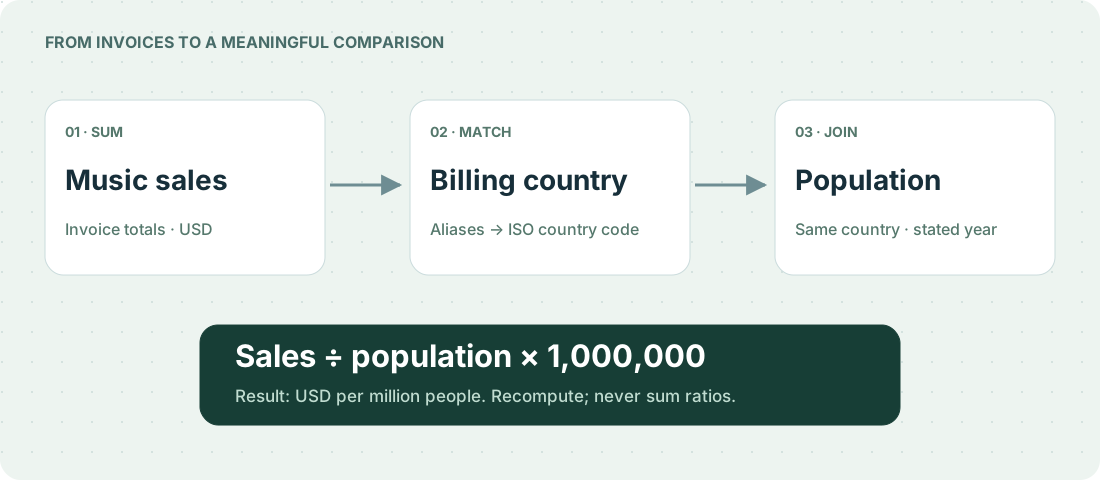
Music sales per capita in Chinook compares the sample store's music sales with the population of each billing country. The result is USD per million people.
It is an example of connecting meanings across datasets: invoice totals supply the money, a country identity supplies the join, and an external population series supplies the denominator. It does not rank the world's real music markets. One sample shop is not the global music industry, even if its query has excellent taste.
Follow the calculation from left to right
- Sum the sales. Add
Invoice.Totalfor the invoices in scope, grouped by billing country. - Resolve the place. Match invoice country names and aliases to shared country values.
- Join the population. Use the country code to obtain the population and retain its observation year and source.
- Divide and scale. Divide music sales by population, then multiply by 1,000,000.
Music sales per million people = music sales ÷ population × 1,000,000
Music sales extends revenue. Population extends the core population measure. The ratio extends per capita. The graph records these relationships so the formula has context as well as arithmetic.
Bigger totals do not always win
In a made-up example, Country A has 50 currency units of sales and 1 million residents. Country B has 200 units of sales and 50 million residents. B leads on total sales; A leads per million residents.
These are invented places and figures, not Chinook invoices or World Bank counts. The bars below show the arithmetic without implying a real-world ranking.
The smaller total wins per person.
Combine totals before dividing again
Together, A and B have 250 units of sales and 51 million residents. Their combined result is 250 ÷ 51 ≈ 4.90 units per million people.
Adding the two ratios, 50 + 4 = 54, gives the wrong combined result. A simple average, 27, treats the populations as equal. The ratio therefore has aggregation none: recompute it from the underlying totals and compatible populations.
What the sample's meaning file says
The file describes 412 invoices dated from 2021-01-01 to 2025-12-22, with quantity always 1 on invoice lines. It states that invoice total equals the sum of line unit price times quantity for all 412 invoices. These are statements about this sample, not general rules for invoices.
The unit for music sales is USD. Chinook itself does not name a currency; the meaning file explicitly interprets its prices as US dollars. Catalogue list price remains separate from the price actually charged on an invoice line.
The measure declares billing country and invoice date as dimensions. Invoice dates are treated as calendar days because the file says their timestamp time part is always midnight.
The denominator comes from outside Chinook
Population is not a music-store column. The graph names the World Bank Population, total series, SP.POP.TOTL, under CC BY 4.0. Its source note records a 2025 snapshot for all 24 Chinook countries at DataTug Chinook demo commit d2fc437.
Chinook's country names, including “USA,” match shared country labels and aliases. Population is joined through the country's ISO alpha-2 code. A missing population excludes that country from the ratio; the query does not invent a count.
The numerator's sales period and the denominator's observation year should remain visible. Dividing several years of sales by one population snapshot does not automatically produce an annual rate.
Read the result with its ingredients
- Show sales, population, and the ratio together. A small denominator can make a tiny sales total look enormous.
- Keep per million people in the column heading. A rate of 50 is not $50 of revenue.
- Group by billing country, as the concept specifies. Customer country happens to agree in this sample, but the concepts have different roles.
- Do not treat residents as customers. The denominator includes people who never bought anything from this store.
The definition records the saved query. This guide explains the calculation; it does not reproduce that query's results.
Explore the ingredients
Read the per-capita guide for paired heatmaps, population for a dated world map, revenue for the sum, country identity for the join, and billing country for the geography of the sale.