An order line is one product or service requested on an order. Written as one word, orderline is the same question. The registry also lists order item and order detail as synonyms. The registered meaning is the short one: one product or service requested on an order.
One order line = one product or service requested on one order
That is the definition used here. The order is the request to supply. The order line is one entry on that request. A search for the meaning of an order line is asking for that entry.
The order is the header
An order is a request or commitment to supply goods or services. It describes intended supply. The header can name who asked, which agreement applies, and other facts about the request as a whole. The lines list what was asked for.
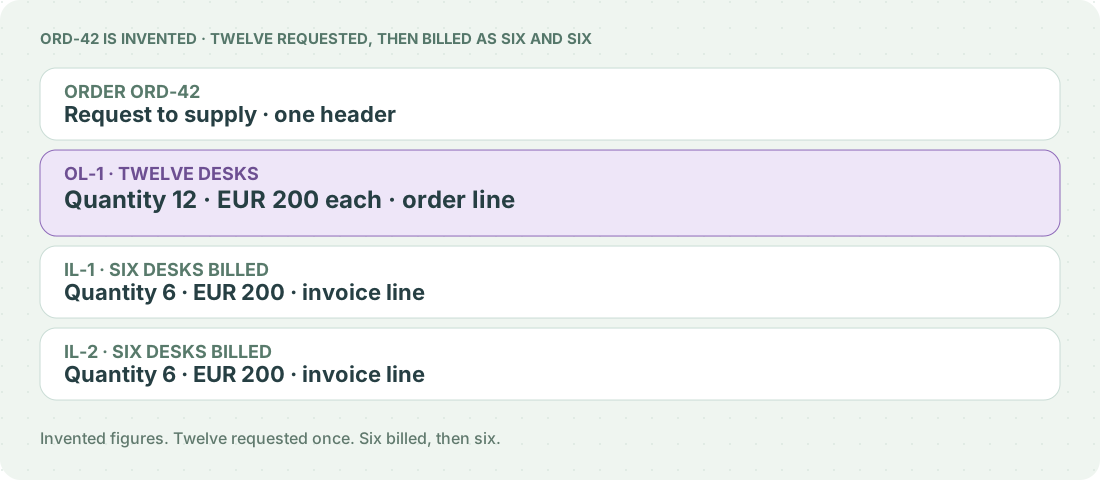
In the invented order from the order that became two invoices, Fern Library asks Cedar Workshop for twelve desks. That request is order ORD-42. Order line OL-1 is the twelve desks, at an agreed illustrative unit price of 200 euro (EUR). The buyer, the workshop, the desks, and the prices are made up. They are not rows from Northwind, AdventureWorks, or Chinook.
A second requested thing is a second line, and the header stays one order. Purchase order, invoice and payment records that shape on PO-104: one order line for a projector and one for a setup service. In the checked example each line has quantity 1. The invoice beside them is a different record.
Order line, invoice line, and line item
Three names sit close together. Each one has a job.
| Concept | Registered meaning | Where it sits |
|---|---|---|
| Order line | One product or service requested on an order | On the order |
| Invoice line | One item on an invoice, with its unit price and quantity | On the invoice |
| Line item | One product or service entry on an order or an invoice, commonly with a quantity and a unit price | On either document, without saying which |
An invoice line is part of an invoice. An invoice is a request for payment for goods or services supplied: what was supplied, when, where it is billed, and the amount charged. The registry's invoice is explicit that this is not an order and not a receipt. The invoice line is one item on that request for payment, with its unit price and quantity.
A line item is the shared shape. The registry name is commercial line item. The description stops before the document's job: the entry does not by itself say whether the document requests supply or payment. An order line extends that shared shape and is part of an order. An invoice line extends the same shape and is part of an invoice.
In the Cedar Workshop example, OL-1 requests twelve desks. Two later invoice lines, IL-1 and IL-2, each charge for six of those desks. The rows can be matched. Requesting twelve and charging for six are different events, so they stay different records. The invoice that arrived before the money follows the bill once it exists.
Quantity, unit price, and the line amount
On an order line, the core graph records the request, not the charge.
Order line quantity is how many were requested on this order line. Order line product is the product requested on the line. Order line service is the service requested on the line. Order line order is the order that carries the line. A line points at a product or a service. The definition does not ask for both.
Quantity and unit price, as core attributes, belong to the invoice line. Quantity is how many were sold on one line. Unit price is the price charged for one unit on an invoice line. Price is the amount asked for one unit, such as a catalogue list price. The price actually charged on a sale is a unit price.
The registry has no separate concept for quantity times unit price on a single line. Invoice total, subtotal, and line total names those three levels, including tax and invoice-level charges the registry does not model as their own concepts. Invoice total is the amount charged on an invoice, normally the sum of its lines. It extends money amount, so the currency stays with the number. The invoice total is a fact about the invoice.
In the invented Cedar Workshop figures, twelve desks at EUR 200 come to EUR 2,400 on that one order line. Each invoice charges for six desks and comes to EUR 1,200, with no other charges in the simplified story. Twelve times 200 is arithmetic for the example. It is a worked line amount, and the invoice total is the EUR 1,200 on each invoice. Copying the EUR 2,400 figure onto both invoices and summing the joined rows reports EUR 4,800. The desks were requested once. The parent figure was repeated. Currency is part of the number is why the euro unit has to travel with every one of those figures.
Why the line is its own entity
An order with one product can be sketched as columns on the header: which product, what quantity, what price. A second product breaks the sketch. A column holds one value. A second desk finish, or a delivery beside the desks, needs another row.
Writing the lines into the header and replacing them keeps only the latest product. The earlier request is gone. Salary history keeps one row for each pay change for the same reason: the fact that repeats is the fact a later question has to find. An order keeps one row for each requested product or service. That row can be matched, supplied, billed, or cancelled on its own.
The registry records the split. The order line is its own entity, part of the order, and a commercial line item. Facts about the request as a whole stay on the order. Northwind's shipping country is one of those header facts: the country to which the order is shipped. It names a destination. It does not name a product or a quantity.
How the samples state it
Northwind's sales order is a customer's order requesting Northwind to supply products. Its sales order line is a product and quantity requested on a Northwind order. The meaning file binds the order to Orders and the line to Order Details, and the line extends the core order line. That file does not register a unit price, a quantity attribute, or a line amount for the line.
AdventureWorks separates header and detail. Sales order is a request to supply goods to a customer, as recorded in a sales order header, and it extends order. Sales order line is one product entry on an AdventureWorks sales order, and it extends the core order line. The file binds the header to Sales_SalesOrderHeader and the line to Sales_SalesOrderDetail. Sales order quantity is the number of product units requested on that line, bound to OrderQty. It extends quantity. That core attribute is defined as how many were sold on an invoice line; this sample's description is how many were requested. Sales order unit price is the unit price recorded on the line, bound to UnitPrice, and it extends price. Unit price, in the core graph, is the price charged on an invoice line.
A purchase uses a different specialization. Purchase order is a request to purchase goods from a vendor, and it extends order. Purchase order line is one product entry on a purchase order. It is part of that purchase order, and it extends commercial line item rather than order line. Purchase order quantity and Purchase order unit price record how many were requested and the unit cost on that line. They extend quantity and price. The labels use familiar words. The registered concept for this line is commercial line item.
Chinook defines no order and no order line. The sample's sale is an invoice. Chinook's invoice line is one track bought on an invoice. Quantity there is how many copies of a track were bought on one invoice line, and the meaning file says the value is always 1. Unit price is the price charged for one copy of a track. Invoice total equals the sum of unit price times quantity over the invoice's lines, and the file says that is true for all 412 invoices. Those sentences describe this sample. They do not say that every order line has quantity 1, because this sample has no order line.
A usable answer names the document and the entry. "OL-1 on ORD-42: twelve desks requested at EUR 200 each" can be looked up again. Whether six of them have been charged is a question for the invoice lines.