An invoice total is the amount due on an invoice: the amount charged, after tax and after any shipping, fees, and discounts that apply to the invoice as a whole. A subtotal is the sum of the line totals on that invoice, before that tax and before those invoice-level charges. A line total is the quantity on one invoice line multiplied by its unit price, after any discount on that line. An invoice line is one item on an invoice, with its unit price and quantity. Value-added tax (VAT) is one kind of tax; the letters VAT stand for value-added tax.
Line total = quantity × unit price − line discount. Subtotal = sum of line totals. Invoice total = the amount due, after tax and invoice-level charges.
That is the reading used here. The three names are three levels on one document. A column called total still has to say which level it holds.
One invented invoice
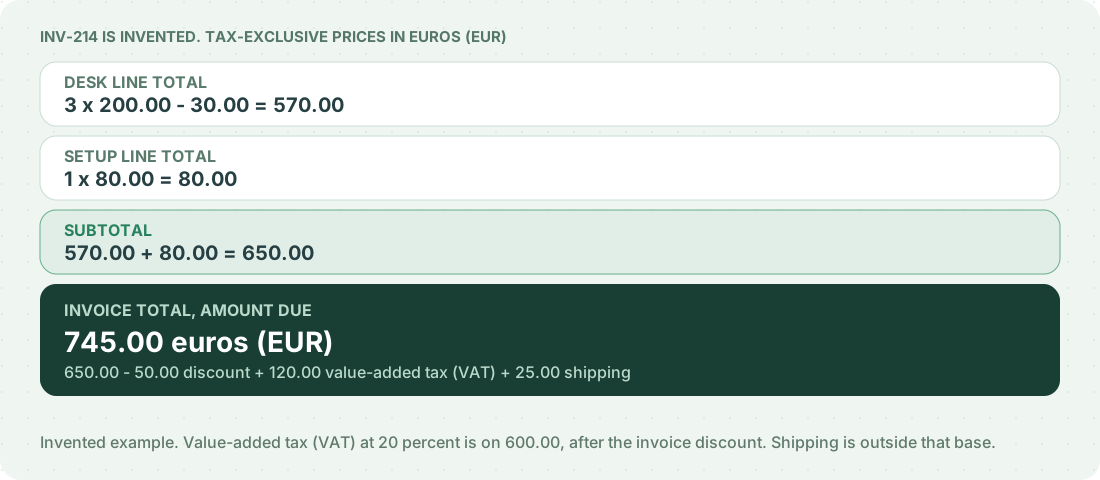
Fern Library is the customer. Cedar Workshop sends invoice INV-214. The people, the workshop, and every figure are made up. Prices in this example are tax-exclusive: the unit price does not already contain the tax. There is no handling fee. Shipping sits outside the tax base. Value-added tax (VAT), for this example only, is 20 percent of the subtotal after the invoice-level discount. That is the arithmetic this illustration uses. It is not a tax rule, and it is not a claim about how often invoices are written this way. The order that became two invoices uses a simpler pair of bills, with no tax and no extra charges. INV-214 is a different invented document. Amounts below are in euro (EUR).
| Line | Quantity | Unit price (EUR) | Line discount (EUR) | Line total (EUR) |
|---|---|---|---|---|
| Desk | 3 | 200.00 | 30.00 | 570.00 |
| Setup | 1 | 80.00 | 0.00 | 80.00 |
The desk is a product. The setup is a service. Each is its own invoice line.
The desk line total is 3 × 200.00 − 30.00 = 570.00 euro (EUR). The setup line total is 1 × 80.00 − 0.00 = 80.00 euro (EUR). The subtotal is 570.00 + 80.00 = 650.00 euro (EUR). The invoice-level discount is 50.00 euro (EUR). Shipping is 25.00 euro (EUR). The tax base in this example is 650.00 − 50.00 = 600.00 euro (EUR). Value-added tax (VAT) at 20 percent is 120.00 euro (EUR). The invoice total is 600.00 + 120.00 + 25.00 = 745.00 euro (EUR).
The 745.00 euro (EUR) is the amount due on INV-214. The 650.00 euro (EUR) is the subtotal. The 570.00 euro (EUR) is one line total. Adding the subtotal to the invoice total reports 1,395.00 euro (EUR). The line totals sit inside both figures, and the invoice total also holds the tax and the shipping.
What the registry records
An invoice is a request for payment for goods or services supplied: what was supplied, when, where it is billed, and the amount charged. An order is a different record. It describes intended supply.
The invoice line is part of the invoice. It extends line item, one product or service entry on an order or an invoice. Unit price is the price charged for one unit of an item on an invoice line. Quantity is how many units of an item were sold on that line. Price is the amount asked for one unit, such as a catalogue list price. The price charged on the sale is the unit price.
Invoice total is an attribute of the invoice. The registered description is the amount charged on an invoice, normally the sum of its lines. The registry also lists total, amount charged, and invoice amount as names for that figure. It extends money amount, so the number keeps its currency. Invoice currency is the recorded currency of the invoice total.
The registry has no concept for a line total, a subtotal, a line discount, an invoice-level discount, shipping, a fee, or a tax. Value-added tax (VAT) is ordinary language here, not a registered concept. A dataset that stores those figures says, in its own model, which column is which. The core graph does not supply the columns.
The phrase "normally the sum of its lines" fits when each line already carries its share of the amount due. When a line total stops at quantity times unit price after the line discount, the sum of those line totals is the subtotal. Tax, shipping, fees, and an invoice-level discount then sit outside that sum, and the invoice total is the amount due after them. The model should say which reading its total column uses.
The order line counts a different event
An order line is one product or service requested on an order. Order line quantity is how many units were requested on that line. Order line product and Order line service name what was requested. The invoice line's quantity is how many were sold on the invoice line. What is an order line? keeps the request and the charge as different rows. In that guide, order line OL-1 requests twelve desks, and two later invoice lines bill six and six. Those quantities are the counts on the rows. They are not line totals, and they are not the three desks on INV-214.
Invoice order can name an order that gives context for the invoice. The link leaves the order line's quantity on the order line. It does not copy that quantity onto the invoice line, and it does not turn a requested value into the amount due. The order that became two invoices follows one request that was billed as two invoices, with no tax in that simplified story.
Rounding, tax inside the price, and the currency
The same words can produce another number. Each figure below is invented, and each one states the rule it uses.
Rounding each line and rounding once on the invoice can disagree by a cent. Take three invoice lines, each with a line total of 9.99 euro (EUR), and the same illustrative 20 percent value-added tax (VAT). Tax on one line is 9.99 × 0.20 = 1.998, which rounds half up to the nearest cent as 2.00 euro (EUR). Three lines give 6.00 euro (EUR) of tax. Tax on the subtotal is 29.97 × 0.20 = 5.994, which rounds half up to 5.99 euro (EUR). The invoice total differs by 0.01 euro (EUR) according to which rounding was stored. The registry does not choose a rounding rule. The dataset records the one it used.
A unit price can already include the tax. Suppose one unit is charged at 12.00 euro (EUR), and that figure includes the same illustrative 20 percent. The net is 12.00 / 1.20 = 10.00 euro (EUR), and the tax inside the price is 2.00 euro (EUR). Treating 12.00 as tax-exclusive and adding 20 percent produces 14.40 euro (EUR). Unit price, in the registry, is the price charged for one unit. The description of the column says whether tax is already inside it.
The currency travels with every one of these amounts. Invoice total extends money amount, and invoice currency records the currency of that total. A bare 745 has no unit. A line total stored in another currency stays out of the subtotal until a conversion is stated, with its rate, direction, and date. Currency is part of the number follows that gap. The starter currencies in the core graph include the euro (EUR), the US dollar (USD), and pound sterling (GBP).
The amount due, the balance left, and revenue
The invoice total is the amount the invoice charges. A later payment can reduce what remains. The outstanding amount is the unpaid remainder on a payment obligation at a stated time. Writing that balance over the invoice total drops the amount the invoice asked for. The invoice that arrived before the money keeps the charge distinct from a recorded payment. The promise behind the unpaid balance follows the allocations behind a smaller remainder.
Revenue, in this graph, sums the invoice totals of the sales in scope, before costs. The measure adds the amount charged. Refunds, taxes, discounts, and recognition policy stay explicit when a dataset has them. The basic concept does not supply that policy, and the sum does not by itself establish money collected. What is revenue? is that measure.
A usable reading of INV-214 names the level and the currency together. The desk line total is 570.00 euro (EUR). The subtotal is 650.00 euro (EUR). The invoice total is 745.00 euro (EUR), with value-added tax (VAT) of 120.00 euro (EUR) at the example's 20 percent and shipping of 25.00 euro (EUR). The amount due is that last figure.