A line total is the amount charged for one invoice line: the quantity on that line multiplied by its unit price, minus any discount given on that line. An invoice line is one item on an invoice, with its unit price and quantity. Quantity is how many units of the item were sold on the line. Unit price is the price charged for one unit of it. A line discount is an amount taken off one line only. A subtotal is the sum of the line totals on the invoice. The invoice total is the amount due on the whole invoice, after any tax and invoice-level charges. Value-added tax (VAT) is one common tax on invoices; the letters VAT stand for value-added tax.
Line total = quantity × unit price − line discount
So "line total" on an invoice means the money for that one row, not for the whole document. What is an invoice total? covers the amount due.
A worked example
Juniper Print Studio sends invoice INV-305 to Harbour Café. The studio, the café, the invoice and every figure below are invented for this guide. Prices are tax-exclusive: the unit price does not include tax. Value-added tax (VAT), for this example only, is 20 percent of the subtotal. Amounts are in euro (EUR).
| Line | Quantity | Unit price (EUR) | Line discount (EUR) | Line total (EUR) |
|---|---|---|---|---|
| Menu cards | 200 | 0.45 | 0.00 | 90.00 |
| Posters | 4 | 12.50 | 5.00 | 45.00 |
| Design session | 2 | 40.00 | 0.00 | 80.00 |
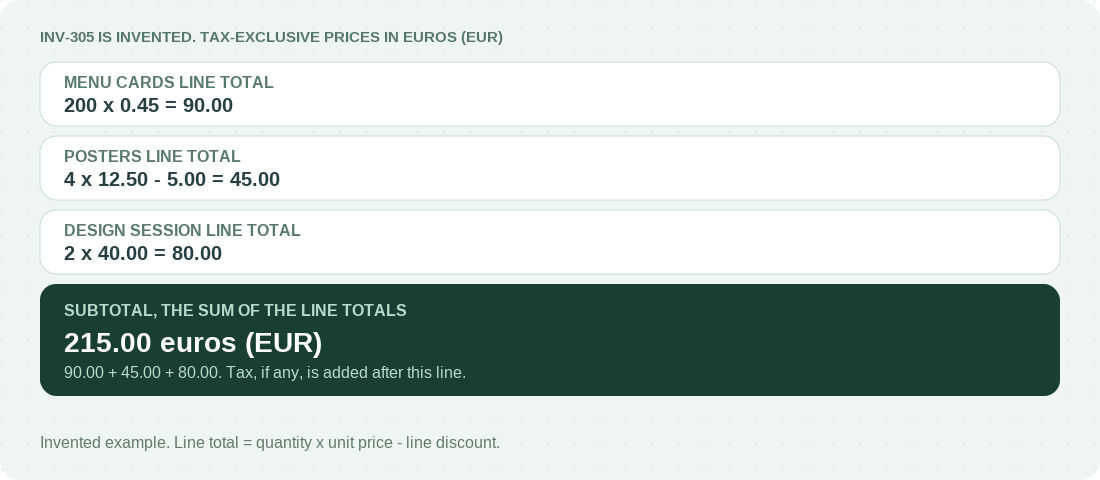
The menu cards line total is 200 × 0.45 − 0.00 = 90.00 euro (EUR). The posters line total is 4 × 12.50 − 5.00 = 45.00 euro (EUR). The design session line total is 2 × 40.00 − 0.00 = 80.00 euro (EUR).
The line totals add up to the subtotal: 90.00 + 45.00 + 80.00 = 215.00 euro (EUR). Value-added tax (VAT) at the example's 20 percent is 43.00 euro (EUR). The invoice total, the amount due, is 215.00 + 43.00 = 258.00 euro (EUR). Each figure answers a different question: 45.00 is what the posters cost Harbour Café, 215.00 is what all three lines cost before tax, and 258.00 is what the café owes.
Does a line total include tax?
It depends on the invoice, so the column has to say. Two conventions are both in use:
- Tax-exclusive line totals, as on INV-305: the line total is quantity × unit price − line discount, and tax is added once, below the subtotal.
- Tax-inclusive line totals: each line already contains its tax. If the posters line were shown with the example's 20 percent included, it would read 45.00 × 1.20 = 54.00 euro (EUR).
Both numbers describe the same posters. Adding a tax-inclusive line to a tax-exclusive subtotal counts the tax twice or not at all. A model that stores line totals states which convention its column uses, and whether the unit price already includes tax.
Currency and rounding
A line total is an amount of money, and an amount without its currency has no unit. The invoice total extends money amount, so it keeps its currency, and invoice currency records the currency of that total. A line in another currency stays out of the subtotal until a conversion, with its rate and date, is stated.
Rounding can make the lines and the invoice disagree by a cent. Take two invented lines, each 7 items at 0.125 euro (EUR). Each line is 0.875 euro (EUR) unrounded. Rounded half up to the cent per line, each becomes 0.88, and the two lines sum to 1.76. Added unrounded and rounded once, the same two lines give 1.75. Neither is wrong. The invoice or the dataset has to say which rule it used.
Line total vs order line total
An order line is one product or service requested on an order. Quantity times price on an order line is the value of a request, not an amount charged. The invoice line is where the charge happens, and one order line can be billed across several invoices. Both extend commercial line item, the shared shape of one product or service entry on an order or an invoice. What is an order line? keeps the request and the charge apart.
Store it or derive it?
The core graph defines the invoice line, its quantity and its unit price. It has no separate concept for a line total, a line discount or a subtotal. A dataset can derive the line total from quantity, unit price and line discount, or store it as its own column. Storing it keeps the figure the customer actually saw, including the rounding that was applied. Deriving it avoids a second copy that can drift from the inputs.
Either way, a column called just "total" is ambiguous. On an invoice table it can be the line total, the subtotal or the amount due, and each gives a different sum. Name the column for the level it holds, and say whether it includes tax and which currency it is in.