Two clocks, one difficult promise
Fictional design agency Lantern Works labels an invoice “due today.” Its customer opens the page in Dublin; its support team reads it elsewhere. Both see the same calendar date stored in the record. Neither knows what instant the application will use to switch the badge to “overdue.”
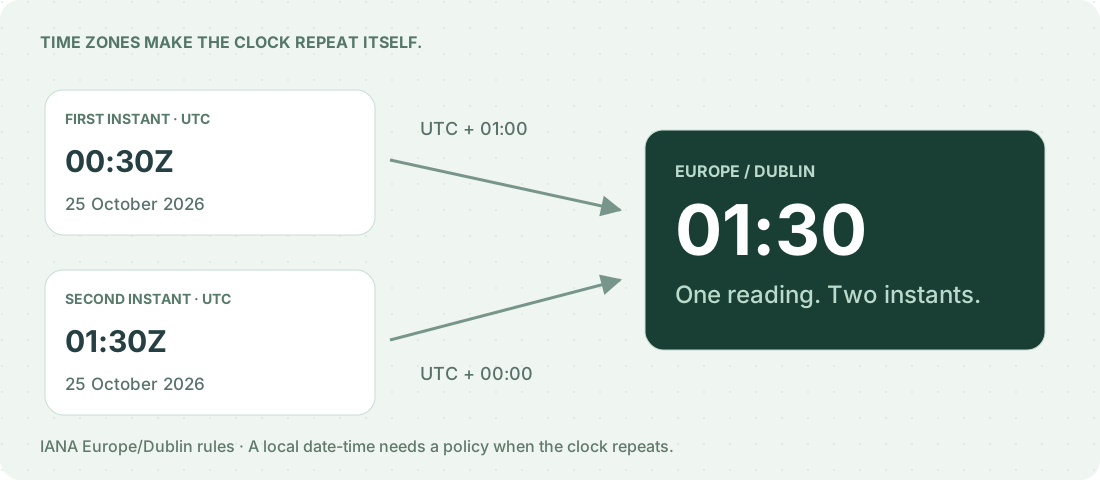
A date looks beautifully simple until someone asks a machine to act on it. Then the machine needs the part of the promise that people left implicit. The diagram shows the underlying difficulty: even an apparently precise local time can refer to two different instants.
The hour that happens twice
Consider two actual instants: 2026-10-25T00:30:00Z and 2026-10-25T01:30:00Z. Formatting them in Europe/Dublin produces local 01:30 on 25 October 2026 in both cases. The first has offset GMT+1; the second has offset GMT. An hour has elapsed even though the wall-clock display repeats.
This example was checked with Intl.DateTimeFormat using the Europe/Dublin zone. It is a small demonstration of why a local date and time without an offset or zone can leave more than one possible instant. A log containing two “01:30” entries has not necessarily duplicated an event. The clock may simply be doing its annual impression of a broken import job.
The IANA Time Zone Database supplies named-zone data reflecting regional clock rules and their changes. A zone identifier represents more than a permanently fixed offset.
A calendar date needs a policy
Date means a calendar day without a time of day. A dueDate of 2026-10-25 therefore does not identify a midnight instant or silently select a region. To calculate a deadline instant, an application must supply a business cut-off, a time zone and a policy for ambiguous or nonexistent local times.
For a fictional policy, Lantern Works could choose 17:00 in Europe/Dublin and publish how it resolves clock changes. That is the agency's application rule, not a consequence of the date concept. Another service may use a different cut-off. Attaching a UTC midnight to every date is an implementation decision with visible consequences, not a neutral storage trick.
Geography is a clue, not the rule
Dublin is a city, and Ireland is a country. Those relationships help readers navigate context, but a customer address does not automatically select the contractual or operational deadline zone. A billing team might administer a project in a different region from the place receiving the work.
City is not a name explores geographic identity. Billing country explains another role a place can play. Neither replaces an explicit time-zone policy. A local clock rule must be named explicitly rather than inferred from a city, a country, or an offset field.
Keep the promise reproducible
Store the original calendar date when that is what the business supplied. When an application derives an instant, keep the zone, cut-off and relevant policy traceable. For recorded events, preserve enough information to distinguish repeated local times and display them appropriately.
An event has more than a timestamp follows occurrence and recording time. The invoice that arrived before the money shows why payment status needs its own evidence. Put those stories together and “due today” becomes a question the model can answer precisely, instead of a promise that changes when somebody travels.